Wednesday, 15 April 2020

Lying low at the Dead Sea, Jordan/Israel border

*WS 136: Lying low at the Dead Sea, Jordan/Israel border*

The Dead Sea is really a lake, forming a natural border between Jordan and Israel/West Bank. It is some 50 km long and up to 15 km wide. The surface of the water in the lake is around 430 m below sea level, making the shoreline the lowest point on earth. The lake itself is up to 300 m deep. The figures are taken from Wikipedia in 2020. The shoreline is receding quite rapidly. It was a much bigger lake during our visit in 2008. 

It is fed by the Jordan River. It has no outlet, dead. The salt content is nearly 10 times higher than water in a normal sea, and a person will just float on the surface because of the high density of the water. It is extremely painful if the water gets into your eyes because of the high salt content.

We were here in 2008 as part of the sight-seeing stops in our pilgrimage to Jerusalem. The mineral-rich black mud is also said to be good for skin care. Shown a friend floating and some muddy people!

Qumran is a village located in the desert at the north-western shore of the Dead Sea in the West Bank. In the 1st and 2nd centuries BC, it was home to the Essenes, a small community of Jewish ascetic monastic brotherhood living in caves and tents. What make this place famous are the Dead Sea Scrolls. In 1949 some shepherds discovered 7 ancient scrolls in a cave. Later archaeological excavations on the cliff faces found many more scrolls and these are called the Dead Sea Scrolls. 

These are parchment writings made some 2,000 years ago. The dry weather has helped in the preservation of the writing. They include most books of the Hebrew Bible and the sect’s own works on rules and codes of ethics. The scrolls are now kept in various Israeli museums. The scrolls proved that the Hebrew Bible and hence the Old Testaments (mostly taken from the Hebrew Bible) remained essentially unadulterated over 2,000 years. 

The place is now a national park with ongoing excavations everywhere. The cave right at the spur at the centre in the 4th photo is where the first scrolls were found by the shepherds. We were viewing it from quite a distance away. The last photo was rather interesting with the bright slanting lines of sunlight. The small museum was crowded. Not that we were curious to see the exhibits, it was simply scourging hot outside.


The Sanctuary of Our Lady of Lourdes, France

*WS 135: The Sanctuary of Our Lady of Lourdes, France*

Lourdes is a small town in southern France. From 11 February to 16 July, 1858, the Virgin Mary, mother of Jesus, was said to have made 18 apparitions to a 14 year old simple farm girl, Bernadette Soubirous in a cave near a village in Lourdes. The girl’s later visits to the cave were followed by thousands of curious people. No other people could see the Virgin except her. Various miracles were said to have occurred at the place during that time, under the watchful eyes of the anti-religious government officers with the incidences well documented. One particular case was a clear spring appeared the next day on the spot where the girl dug into the ground and drank some muddy water the day before. 

The water from the spring has since became the source of claims of miraculous healing. The Catholic Church has since set up a Medical Bureau manned by medical specialists in various fields (may not be Catholics) to examine the truth of the claimed healing. Since 1905, more than 7000 cases were submitted and by 2017 the Bureau declared that 69 of the healing cases are considered “beyond scientific explanation”. The religious called them miracles.  

In 1862, the Catholic Church declared that the apparition story was “worthy to believe”. It is up to the followers to believe it or not. A small chapel was first built here in 1866. Now the sanctuary is a complex of many churches and other buildings, to cater for some 6 million pilgrims a year, for hope of healing or spiritual renewal. This is a popular pilgrimage site for Malaysian Catholics. 

In 2016 we made a 4 night pilgrimage stay at this town of Lourdes, which has more hotels in France than any other cities except Paris. The first photo shows the cave where the Virgin Mary was said to have first appeared and a status of her, the likeness as described by the girl Bernadette who later became a nun. Many of the Malaysian Catholic churches have such a grotto set-up outside their church buildings. The next is a scene of a morning mass held in front of the cave. 

The 3rd photo shows the Crypt, the small rock cave chapel blasted out of the rock slope completed in 1866. The next shows the Basilica of the Immaculate Conception, the 2nd of the churches to be completed, in 1876, built over the Crypt. 

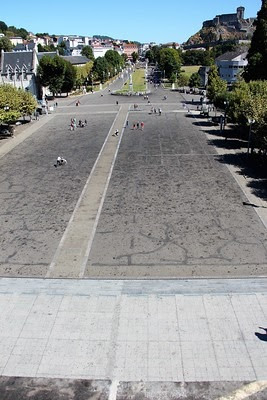
The 5th photo shows a photo of our big family group in front of the 3rd church constructed: the Rosary Basilica completed in 1901. The next shows the lateral view of the two basilica mentioned earlier. The 7th is the interior of the Basilica of St. Pius X, also known as the Underground Basilica, the largest of the churches, completed in 1958. The capacity is 25,000. The 8th photo shows the main open space, called the Rosary Square, where processions are held. 

The last 2 photos show scenes of the daily prayer procession at the Rosary Square. There are many volunteers to help the sick or handicapped pilgrims.


四川省峨眉山市的峨眉山金顶 the Golden Roof at Mount Emei, Sichuan, China

WS 134: 四川省峨眉山市的峨眉山金顶 the Golden Roof at Mount Emei, Sichuan, China 

峨眉山位于四川省成都市西南一百六十公里处,属峨眉山市境内,是中国四大佛教名山之一。

峨眉山主峰是普贤菩萨的道场,峨眉山金顶,最早的建筑传为东汉时的普光殿,寺庙建筑群林立,在鼎盛时期,它拥有超过五百座建筑物,1972年一场大火烧毁了大部分建筑物,包括各类文物,如佛经书画等。1986省政府出资开始重建,1989年建成,目前有大约三十座建筑物。这是联合国教科文组织世界遗产。我们2008年曾到此游览。 

金顶的主要寺庙是华藏寺,俗称金顶金殿,始建于唐朝,海拔3,079米。 华藏寺低到高分布着三重殿堂:弥勒殿,大雄宝殿和普贤殿,即金殿。第三张照片所示的是大雄宝殿中供奉着铜质金身的三身佛之一,坐高三米。这里香客众多,香火鼎盛。另一座大建筑物是银殿,其一边是六百米的断崖, 第五张照片。 

2006年新添了一座金顶十方普贤像,加台座总高四十八米。普贤的十个头像分为三层,神态各异,代表了世人的十种心态。台座高六米,四面刻有普贤的十种广大行愿,如第九张照片所示。六牙白象是普贤菩萨的坐骑,白象雕塑比比皆是。

Mount Emei is located 160 km southwest of Chengdu, the capital of Sichuan Province in China. It is one of the four famous sacred Buddhist mountains in China. The peak is 3,079 m in elevation. 

The temples of Mt Emei is the domain of bodhisattva Puxian. The first temple was built during the Eastern Han Dynasty or slightly over 2,000 years ago. In its heyday, it had more than 500 buildings. The main temple had gilded roof hence the complex was called Golden Roof. In 1972, a fire destroyed most of the buildings in the complex. The provincial government funded the reconstruction project in 1986 and it was completed in 1989. There are currently about 30 buildings. This is a UNESCO World Heritage Site. We visited here in 2008.

The main temple is “Huazang” nick-named Jinding (or golden roof). The 3rd photo shows one of the three gilded statues of the Buddha in one of the 3 halls, the image 3 m in height. Another big building is the Silver Hall, with a 600-meter cliff on one side, 5th photo.

In 2006, a 10-headed statue of bodhisattva Puxian was added, each face with a different expression to represent the ten mentalities of the people in this World. The total height is 48 m. The pedestal is engraved with the ten wishes of Puxian, 9th photo. The 6-task white elephant is the mount of Puxian, and white elephant sculptures abound in the complex.


The tiny British colony of Gibraltar in the Iberian Peninsula

*WS 133: the tiny British colony of Gibraltar in the Iberian Peninsula*

Gibraltar is a colony of the United Kingdom located at the southern end of the Iberian Peninsula. It was ceded by the Spanish to the British in 1713. It has an area of 6.7 sq km (about 7% of Petaling Jaya), and some 32,000 people. Ethnically it is very diverse:  British, Spanish, Italians and Portuguese. 

When we were touring Spain in 2017, we joined a one-day bus tour to this tiny “thorn in the Spanish fresh” from our base in Malaga. The main attraction and landmark is the Rock of Gibraltar, a limestone piece rising steeply from the sea up to 
426 m high. Shown the rock viewed from the Europa Point, the southernmost point of Gibraltar with an old iconic light-house built in 1841. 

At the top of the rock one could have a panoramic view of the city and a close encounter with some of the 300 Barbary macaques. There is also a series of limestone caves collectively called Saint Michael's Cave. In the city the iconic red British phone box is a sort-after photo location. Two main roads cross the runway of the small international airport which has over 20 flights a day during peak season.


The majestic Hagia Sophia in Istanbul, Turkey

*WS 132: The majestic Hagia Sophia in Istanbul, Turkey*

After covering the Suleymaniye Mosque, I feel compelled to introduce the Hagia Sophia whose glamour the Mosque was built to compete.

Hagia Sophia ("Holy Wisdom”) is the Christian cathedral built in 532 -537 AD in Constantinople (present-day Istanbul) during the reign of the Byzantine Emperor Justinian I. 

It was the world's largest building and an engineering marvel of its time. It remained the world's largest cathedral for nearly a thousand years, until the Seville Cathedral was completed in 1520.

In 1453, the city was conquered by the Ottoman Empire and soon the cathedral was turned into a mosque. In 1935 the 1st President of the modern Republic of Turkey, M K Ataturk, transformed it into a museum and it remained so until today. 

The Hagia Sophia is of masonry construction with a first floor gallery. The central dome is 55.6 m from floor level and rests on an arcade of 40 arched windows. The windows provide ample light to the interior and reduce the weight too. It is slightly elliptical, with the diameter near 31 m. There are other half domes of identical diameter to the central dome. Interior surfaces are sheathed with marbles, green and white with purple porphyry, and gold mosaics. The exterior, clad in stucco, was tinted yellow and red during restorations in the 19th century. 

The design of the great dome at the Hagia Sophia has been copied by many churches later and even the mosques of the Ottoman Empire. 

The first 2 photos show the exterior. The minarets were Ottoman additions. The next 4 the interior with the domes and half domes. 

The 7th photo shows one of the many chandeliers. The 8th photo shows a part on the floor below the main dome called the “Omphalion” made up of 32 pieces of marble in different sizes. It was where the Byzantine emperors were crowned. The 9th and 10th photos show the famous mosaic pieces, dating to the 9th and 10th centuries respectively. The one at the apse showcase the 4 m high Virgin Mary with Jesus, and the one at the south-western entrance with Virgin Mary, Emperor Constantine and Emperor Justinian I.


The beautiful Suleymaniye Mosque in Istanbul, Turkey

*WS 131: the beautiful Suleymaniye Mosque in Istanbul, Turkey*

We were in Istanbul, Turkey on a free-n-easy trip for 5 days in 2012. We visited quite a few big mosques, and the most beautiful to us is this Suleymaniye Mosque, not the more famous Blue Mosque. This is a mosque built by Sultan Suleyman of the Ottoman Empire in 1557 and named after him. His intention was to build a mosque comparable in standing to the Christian cathedral Hagia Sophia built over a thousand years earlier. 

Like in all royal mosques there is a central courtyard with 4 minarets at the corners, each 74 m tall. The courtyard has a colonnaded peristyle (veranda) with granite and marble columns. The interior is almost a square, 59 m by 58 m, forming a single vast space.  The main dome is 53 m high and a diameter of 26.5 m or half the height, based on the design of the dome in the Hagia Sophia. There are many more smaller domes and half domes. 

The interior is simply beautiful with a giant chandelier hanging below the main dome. It is well decorated with stained glasses and Iznik tiles which are special ceramic titles produced in Iznik in Turkey during the Middle Ages. The 7th photo shows a decoration while the 8th the mihrab, a niche in the wall indicating the direction of Mecca.