Showing posts with label Bolivia. Show all posts

Saturday, 16 January 2021

旅游小插曲 (13)

这个也是发生在玻利维亚的故事。在玻利维亚的西部安第斯山脉的高原区,有个名叫欧鲁录(Oruro)的城市,海拔三千七百米,人口二十多万,是国内第五大城市。每年二月下旬,这里会举行一个大型嘉年华会,规模是南美第二,仅次于巴西里约热内卢的桑巴舞嘉年华会。 

这个庆典本来是原住民(Uru部族)的一个传统节日。十六世纪,西班牙人占领南美,许多原住民改信天主教,这个节日慢慢变成天主教会的庆典,记念一个教会圣女显灵救人的事。整个庆典约十天,那大型舞蹈的嘉年华会是在天主教圣灰主日的前一个周末和周日举行。星期六的舞蹈游行最热闹,涉及多个不同舞蹈的团体,约有两万名舞蹈员和一万名乐师参与,舞蹈队伍长达四公里,观众可达四十万人。星期天的游行,规模就小一点。 

2009221日星期六我们在这里呆了三、四个小时,坐在临时搭的看台上,看一组组的舞蹈队伍着过。里约热内卢的桑巴舞嘉年华会的舞蹈员以穿三点式舞衣闻名。这里的穿着就较保守,不是民风保守,而是太冷了,高原海拔三千七百米哦!游行的高潮是圣军对垒邪魔,代表邪魔的舞蹈员穿着奇装异服,看者目不暇给。

我要谈的细节是这里的水战。在这庆典的十天里,欧鲁录镇是个战场,玻利维亚人都上街水战,使用各种武器:充水气球弹,泡沫喷雾罐,半自动水枪,小型水车,等等。我们的小巴停在离舞蹈游行的街道约三、四百米远的路口,实在太多人,车要停在远处。当地导游已为我们准备了薄薄有头罩的雨衣,大家一下车赶快武装起来,不到一分钟就有充水气球弹飞过来。走路去看台时,大批小孩成人都公开卖武器,我们的团友多有光顾,买泡沫喷雾罐为多。

我们坐在临时搭的看台时,不时受到暗袭,大家杀到天昏地暗。看第二张照片中的两个重伤者。

补充一下:人多的地方就有扒手,一位团友的背包被割开,损失了一个小相机。


旅游小插曲 (12)

游览过这奇怪名字的危地马拉,再去另一个奇怪名字的国家-玻利维亚(Bolivia)2009年我们去南美的秘鲁和玻利维亚游览,三个半星期。这里要讲的也是过移民局关口的故事。

在秘鲁的布诺镇(Puno),我们游览了世界有名的高原湖泊Lake Titicaca, 接下来是过境去玻利维亚。不过首先我们要在布诺镇的玻利维亚领事馆申请入境签证,我们这一团约二十个人,大家清早就去领事馆填表格,等面试。我们的领队,就是危地马拉的那位,是第三次带团来这里,已是老马,识途也。他那天带来一瓶免税美酒孝敬阿头,领事大人。那本地导游则带了好几罐的可口可乐,派给警卫和职员。两三个小时入境签证就搞定。什么排队面试?不过我们走时,领事大人还是有出来跟我们打个招呼,欢迎我们来(或去)玻利维亚。 

当天下午要去打黄热病(yellow fever)疫苗。进入玻利维亚需要打这疫苗的证书,进入秘鲁就不需要。未来之前我们的领队说我们不必在马来西亚打,因为很贵。他说在布诺镇这里的政府药房打,只收十多美元,马来西亚贵三四倍。问题来了,本地导游说不久前有新的条例,非秘鲁公民不能在政府药房打。怎么办?导游打了几个电话,说他和领队会想办法。我们下午就在市镇上自由行,到了晚上已拿到证书。不必打针,每个人都有一份打过疫苗的证书,大概是遥控针吧。有钱能使鬼推磨,贪污舞弊是世界共同文化,不必联合国教科文组织去颁什么世界遗产证书。怎么,你五年级时考试作弊给老师罚站三十分钟吗?那是他不识世道。我当然有作弊啦!不然怎么有这样好的成绩! 

从秘鲁进入玻利维亚的边疆市镇名为Desaguadero,离布诺镇两、三个小时的路程,我们是坐大巴经过的。市镇非常热闹,门庭若市,跟墨西哥进入危地马拉的关口有天渊之别。玻利维亚移民局的关口好像开着三条线,还是大摆长龙,可能是几辆大巴一起到吧。我们排队而过,到官员的矮桌前,我们开着护照的其中一页,有地方打印的就行,疫苗证书就放在旁边,那官员也没看我们一眼,就在护照上打印了。完全没有翻护照的个人资料的部分来看,护照是否过期?疫苗证书持有人是不是护照持有人?我们填写的入境表就丢在一个纸盒里。我想那些没有疫苗证书的,用几张一美元的纸币来取代疫苗证书当然行得通。玻利维亚比危地马拉还穷,没有人要偷度进来!不过这是十一年前的事,现在应该有做电脑记录了吧! 

看了这故事,你会觉得第三世界是不是更好玩?这间大马旅游社承办的秘鲁-玻利维亚游,非常受欢迎,现在一年至少有三个团。那领队就是老板。 

照片所示的是玻利维亚首府La Paz的一个早市,这里的女人很喜欢带高帽,大概是老公送的吧。这里盛产鳄梨(avocado)和百香果(passion fruit),售价是马来西亚的三份一。

Friday, 8 January 2021

The Oruro festival in Bolivia ( re-post )

 *WS22 ( re-post ) - the Oruro festival in Bolivia*

The 3rd festival I want to present is that at Oruro, a highland town in west Bolivia with about 260,000 people. We were in Oruro in 2009. 

This Carnaval de Oruro might be less famous than the samba dance festival in Rio de Janeiro in Brazil, it is still a very famous one in South America. Started as a religious festival about 200 years ago, this is a UNESCO Cultural Heritage event. More than 30,000 dancers are involved, covering 2 days, with over 400,000 spectators. 

Not many bikinis compared to the one in Brazil because it is colder here, but still an eyeful of cleavage and thighs. We stayed here for about 4 hours. 

The parade was accompanied by throwing of water bombs and firing of foam sprays. It was like an anti-terrorist drill to the tourists. Everybody played the game. We were both victims and villians. We had to protect ourselves with plastic ponchos. Good entertainment.

(Photo credit: photos of dancers are mostly not mine, but the tour leader's because we were at the stands while he was allowed to move with the dancers, being a tour leader) .


The salt lake of Salar de Uyuni, Bolivia ( re-post )

 *WS 04 ( re-post ) - The salt lake of Salar de Uyuni, Bolivia*

Salary de Uyuni is a salt lake in Bolivia with an area of 10,600 sq km, 1.3 times bigger than Selangor. The salt is not your typical kitchen salt but mainly a rich mix of sodium, lithium and magnesium chlorides. It is estimated the lake contains 50% of the World's reserve of lithium. The top 10 to 20 ft is a hard crust which allows light vehicles to be driven on it. 

We were here in 2009. Some distance into the lake the white glittering surface extends in all directions from us to merge with the sky. 360 degrees. Just nothingness but we and our 4-wheel-drives. Simply surreal.  When there is water on the surface the whole surface is glittery. Unfortunately all that glitters is not gold.

Near to the centre there are some islands heavily infested with giant cactus. We had our open-air packed lunch on the big island called Incahuasi. That evening we stayed at the basic salt hotel, where the floors, walls, tables, chairs, beds, etc are made of salt blocks. And there is only 1 power point. Everybody charging their phone and camera batteries from the same point.

Quite a few movies had their location shooting here. The most famous is Star Wars: the Last Jedi (2017).


Wednesday, 13 May 2020

Freezing in the Bolivian central plateau, Bolivia

*WS 157 –Freezing in the Bolivian central plateau, Bolivia*

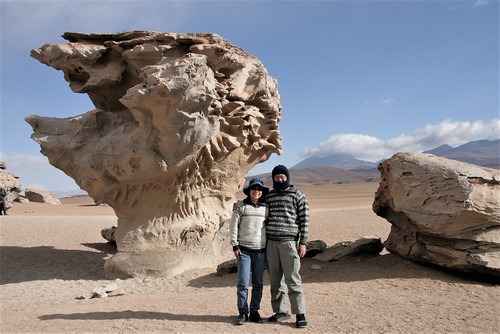
The Eduardo Avaroa Andean Fauna National Reserve is a huge reserve in the central Bolivian plateau around 4,200 to 5,400 m level. Within this reserve are several wildlife sanctuaries. We spent 3 days and 2 nights in this region in 2009, with freezing temperature at night, even in summer. 

Shown our convoy of 4 four-wheel-drives, over mostly dusty rocky terrain, a village and the famous “Stone Tree” a ventifact carved by wind-brown sand. Also Rails to No-where, an abandoned line to a mine closed some 60+ years ago, and the famed train graveyard. 

Then the blue Laguna Colorada at 4,278 m, and a hot spring pool. Fauna: flamingos and the llamas. Flora: quinoa the famed high-protein Incan rice and the endemic Peruvian feather-grass, Stipa Ichu.


The Death Highway in Bolivia

*WS 141: The Death Highway in Bolivia*

There is this road linking the capital La Paz with a town called Coroico, built by prisoners of war in the 1930s. It is a narrow road but meant for 2-way traffic, even used by big trucks and buses. High steep slopes above, deep ravines below, sharp bends, with no guard rails, unpaved surfaces, poor visibility and slippery on rainy days, which is often – a recipe for fatal accidents. In the 1990s there were over 200 people killed in accidents each year. In 1995, the Inter-American Development Bank rated the 80-km road the Most Dangerous Road in the World.

In 2009, when we were in Bolivia, we drove on this Death Highway. Wow, bo-kia-si eh? Actually most part of this Death Highway were no more in “real use”. There is an improved new highway completed 2+ years ago linking La Paz and Coroico. This old road now attracts only foolish tourists like us and the mountain bikers. They are promoting the road as the Death Ride for Bikers. 

See the steep and high slopes below and above the road, and eroded sections. Note the narrow road surface in the 3rd photo. The 4th shows a plague commemorating a major accident location. Parts of the new highway are in fact improved sections of the old Death Highway, widened to multiple lanes, asphalt-surfaced, etc. But water still comes onto the road.

It snowed at the highest section in mid-summer. The alpacas and llamas also came out to play. The altitude at this high point is about 4,650 m.


*************************

Saturday, 20 July 2019

the highland lake of Titicaca bordering Peru and Bolivia

*WS54 – the highland lake of Titicaca bordering Peru and Bolivia*

Lake Titicaca is a large highland lake (altitude: 3,710 m) bordering Peru (55%) and Bolivia (45%), slightly bigger than our Selangor state. Five rivers feed the lake but it has only 1 river outlet. 10% of the water flows out and 90% of it are lost through evaporation, due to strong winds and the intense sunlight at high altitude. This is a very unusual phenomenon.  

The main attractions on this lake are the 30+ man-made islands, called Uros. They are made up with layers of reeds called "totora" and the islands are movable. They are actually inhabited, by about 1,500 people, hunters and fishermen. Some islands are open to visitors for a fee. The hosts would demonstrate how to make things from the reeds, etc. And the boats for their transport are made of reeds too. 

We were here for a few hours in the morning and later had lunch at the shore, grilled fish of course.  

(2009 digital photos, blurry a bit)